
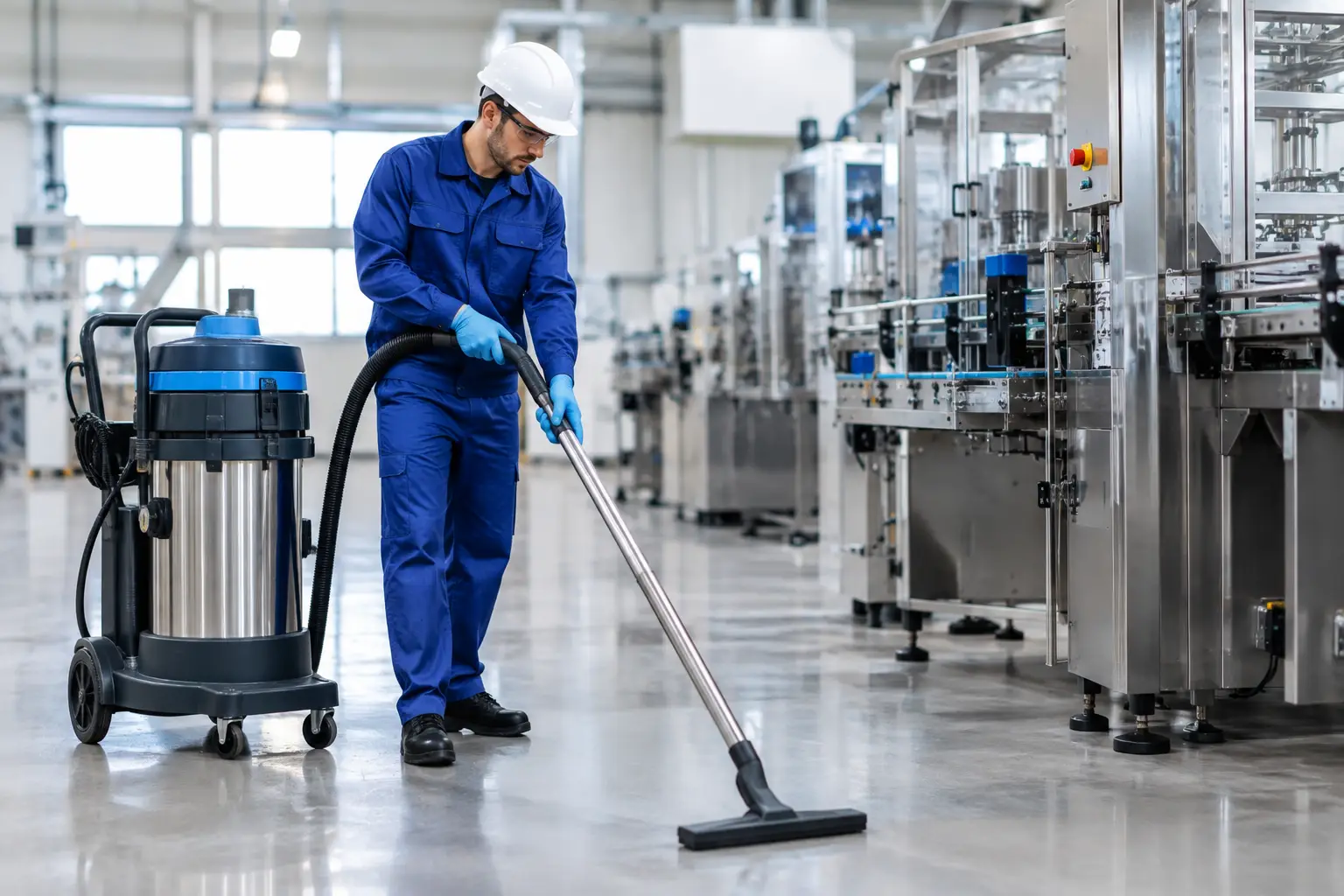
A blocked extraction point, a spill around a machine base or swarf building up beneath a production line can turn a short cleaning task into lost operating time. To reduce cleaning downtime, industrial sites need more than additional labour or a domestic-grade machine. They need equipment matched to the material, volume, duty cycle and safety requirements of the job.
The right vacuum solution allows teams to remove waste at source, recover material quickly and return equipment or work areas to service with less disruption. It also helps prevent small housekeeping issues from becoming safety incidents, equipment faults or extended maintenance stoppages.
Why cleaning creates unnecessary downtime
Cleaning downtime is rarely caused by one issue alone. In many facilities, operators must stop work to fetch a machine, change unsuitable filters, empty undersized containers or move a portable unit across a large site. If the vacuum repeatedly loses suction when handling fine dust, wet material or heavy swarf, the task takes longer and the production area remains unavailable.
There is also a planning problem. Cleaning is often treated as a reactive activity, carried out only after dust accumulates, a leak develops or material starts interfering with machinery. At that stage, access may be restricted, contamination may have spread, and the clean-up may require a planned stoppage rather than a brief intervention between shifts.
For high-intensity manufacturing, engineering and maintenance environments, the objective is not simply to clean faster. It is to make recovery work predictable, safe and proportionate to the process.
Reduce cleaning downtime by matching the vacuum to the task
A vacuum cleaner is only productive when its specification reflects the material being collected. This means considering particle size, density, moisture content, temperature, quantity and whether the waste has any hazardous properties. A unit suited to general dry dust may be the wrong choice for coolant-contaminated swarf, abrasive debris or large volumes of fine powder.
Select appropriate collection and filtration
Fine dust presents a particular challenge. Poor filtration can allow dust to bypass the system or block filters quickly, reducing airflow and forcing frequent manual intervention. A correctly specified filtration arrangement protects suction performance while supporting cleaner air around the work area.
For wet applications, the collection vessel, float system and discharge method matter just as much. If operators need to struggle with a heavy container or repeatedly decant recovered liquid, the apparent saving of a basic machine soon disappears in labour time. A wet and dry industrial vacuum with practical emptying arrangements can significantly shorten maintenance tasks around machinery, pits and process equipment.
Metalworking applications require further consideration. Swarf can be sharp, heavy and mixed with cutting fluid. The equipment must withstand this material without creating difficult emptying procedures or exposing staff to unnecessary manual handling risks. Where valuable coolant can be separated and recovered, the operational benefit may extend beyond cleaning time.
Choose portable, fixed or centralised extraction carefully
Portable machines are often the most sensible answer where cleaning points change regularly or where maintenance teams work across several locations. They provide immediate access to high suction without the cost and disruption of a fixed installation.
However, a portable machine is not always the fastest option. On larger sites, operators can lose significant time transporting equipment between lines, finding power supplies and manoeuvring hoses around active operations. A centralised vacuum system can serve multiple fixed cleaning points, allowing material to be removed where it is generated. This can be particularly effective for continuous dust control, production-line housekeeping and facilities with repeatable cleaning routes.
The trade-off is that fixed systems require proper design. Pipe runs, suction demand, simultaneous users, collection capacity and discharge arrangements must all be assessed before installation. An undersized central system can create a new bottleneck, while a well-designed system reduces travel time and supports consistent standards across the site.
Build cleaning into production and maintenance routines
The fastest clean-up is often the one that never becomes a major clean-up. Instead of relying solely on end-of-shift housekeeping, identify points where dust, offcuts, powders, liquids or swarf are generated and remove them during the process where practical.
This may mean positioning a vacuum close to a machining centre, assigning equipment to a production cell or including extraction tasks within planned preventive maintenance. When responsibility is clear and equipment is immediately available, staff are more likely to address minor build-up before it affects access, machine performance or safety.
Cleaning frequency should still be realistic. Over-cleaning can consume productive time without reducing risk, while under-cleaning allows material to become compacted or spread into difficult-to-reach areas. The correct interval depends on the application, production rate, material type and the consequences of contamination. A steelworks handling heavy scale will have very different requirements from an electronics assembly area dealing with fine dust.
Remove delays caused by emptying and disposal
Collection capacity directly affects uptime. A small container may be easy to move, but it can force operators to stop repeatedly during a high-volume task. A larger hopper or discharge system reduces interruptions, provided it remains safe to handle and suitable for the available waste route.
Before specifying equipment, consider what happens after recovery. Is the material tipped into bins, returned to a process, separated for recycling or treated as hazardous waste? The answer influences the best collection method. Systems designed for pneumatic transport or material recovery can reduce handling steps where powders, granules and production residues need to be conveyed rather than simply collected.
Waste segregation is equally valuable. Mixing recyclable swarf with general debris, or clean product with contaminated material, can add cost and delay disposal. Purpose-designed accessories and collection arrangements can keep recovered materials separate from the outset.
Protect uptime with operator-friendly equipment
Even high-performance machinery will not reduce cleaning downtime if it is difficult to use. Hoses should reach the work without excessive joins, tools should suit the surface and debris, and controls should be understandable for the people carrying out the task. A machine that is awkward to manoeuvre, hard to empty or rarely positioned near the work area will be used inconsistently.
Training should cover more than start-up and shut-down. Operators need to recognise when filters require attention, how to empty collection vessels safely, which accessories are appropriate, and when a change in material may require a different approach. This reduces avoidable damage and helps maintain reliable suction performance.
Routine inspection is also essential. Check hoses for blockages or wear, seals for air leaks, filters for loading, and wheels or castors for damage. These small checks are far less disruptive than discovering a failed machine during an urgent spill response or planned shutdown.
Do not compromise safety for speed
Fast cleaning only improves productivity if it is safe. Dusts, powders and vapours may require specialist consideration, particularly in potentially explosive atmospheres. Where ATEX-rated equipment is required, the vacuum, accessories and operational procedures must be appropriate for the classified zone and material involved.
Similarly, hot materials, conductive dust, oil spills and chemical residues can demand specific machine construction and recovery methods. Using an unsuitable cleaner may expose personnel to risk, damage equipment or create a compliance issue that takes far longer to resolve than the original cleaning task.
A site assessment should therefore account for the material, the environment and the cleaning process itself. Forvac Industrial approaches this as an engineering decision, helping customers identify whether a portable industrial vacuum, fixed installation, dust collector or material-handling system offers the most practical long-term result.
Measure the time that cleaning actually costs
Many sites know cleaning is disruptive but have not measured where time is being lost. A short review can reveal whether the main issue is travel time, slow collection, blocked filters, frequent emptying, poor access or waiting for shared equipment. Once the cause is known, the solution becomes more targeted.
Track the duration of routine cleaning tasks, unplanned clean-ups, machine stoppages linked to debris, and time spent maintaining the vacuum itself. Include the number of people involved and any production delays. This gives operations and procurement teams a clearer basis for comparing a lower-cost machine with a properly specified industrial solution built for continuous work.
Reducing cleaning downtime is ultimately about keeping people, equipment and processes ready for work. When recovery equipment is specified around the real demands of the site, cleaning becomes a controlled part of production rather than an interruption that repeatedly takes the operation off schedule.
