
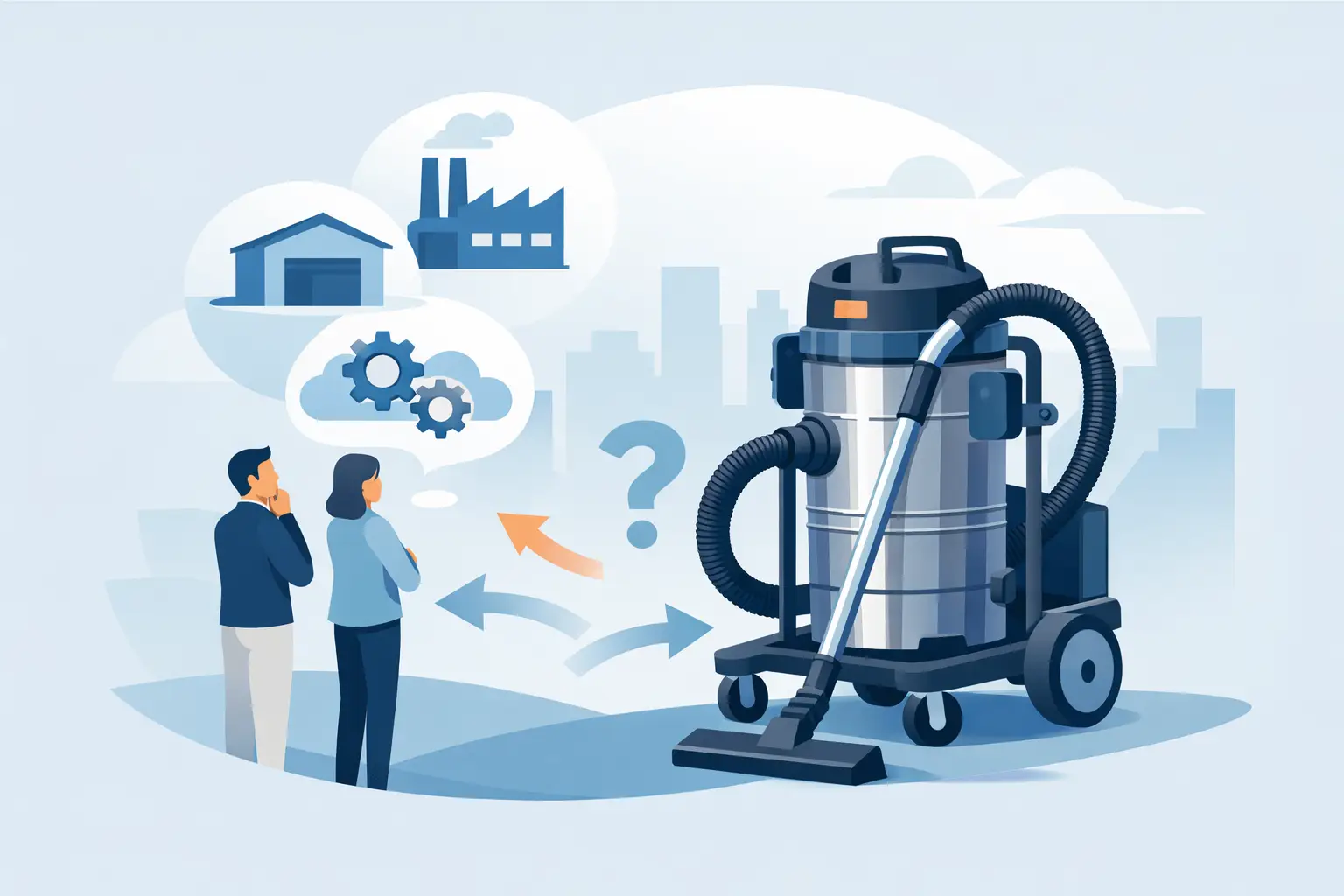
A portable industrial vacuum cleaner earns its place when cleaning cannot wait for fixed infrastructure. In busy production areas, maintenance bays and heavy-duty workshops, waste appears where the work happens – metal swarf beside machine tools, fine dust around cutting processes, oil spills near plant, and debris across access routes. The right unit gives teams a fast, controlled way to remove material at source without compromising safety or slowing output.
That sounds straightforward, but portable does not mean one-size-fits-all. In industrial settings, mobility is only one part of the decision. Suction performance, filtration, waste type, duty cycle, discharge method and site safety requirements all matter just as much. Choosing well means looking beyond headline power figures and focusing on how the machine will perform in your actual working environment.
What a portable industrial vacuum cleaner should deliver
A true portable industrial vacuum cleaner is built for regular use in demanding conditions, not occasional housekeeping. It should cope with abrasive material, heavier waste streams and longer operating periods than commercial cleaning equipment. On many sites, that means collecting dust and solids one day, then dealing with swarf, granules or liquid waste the next.
The key advantage is flexibility. Portable units can be moved quickly between machines, production lines, mezzanines and maintenance areas. That makes them especially valuable where cleaning demand shifts throughout the day or where installing a centralised system is not necessary for every process.
Portability, however, should not come at the expense of build quality. In practice, industrial users need a compact machine that still offers durable construction, dependable suction under load and the right form of filtration for the material being collected. If a vacuum is easy to move but struggles with the waste stream, it creates delays rather than solving them.
Start with the material, not the machine
The fastest way to narrow the choice is to define exactly what the vacuum will be handling. Dry dust, fine powder, coarse debris, metal chips, oil-contaminated swarf, liquids and mixed waste all place different demands on the equipment.
Fine dust often calls for higher-grade filtration and careful containment, particularly where airborne particles affect health, product quality or machine reliability. Heavier waste such as shot blast residue or metal offcuts may demand stronger suction, tougher collection containers and discharge systems that reduce manual handling. Wet applications introduce another layer, as liquid recovery capacity, separation and disposal become part of the specification.
Mixed material is where mistakes often happen. A buyer may choose a machine based on the most common waste type, only to find it performs poorly when the process changes. If your operation produces both dry and wet waste, or both fine and coarse material, the vacuum needs to be selected around that reality from the outset.
Dust, swarf and liquids all behave differently
Dust can block filters, reduce airflow and create exposure risks if the machine is not designed for fine particulate. Swarf can be sharp, heavy and awkward to discharge. Liquids can affect filtration, add weight and complicate emptying. A portable unit that handles one of these very well may not be the right answer for another.
That is why application detail matters more than broad product labels. Two businesses may both ask for an industrial vacuum, but a fabrication shop cleaning steel shot and a food processor recovering powder residues are dealing with entirely different operational demands.
Performance is more than motor size
It is easy to focus on wattage or a simple suction claim, but industrial vacuum performance depends on the balance between airflow, vacuum pressure and how the machine sustains that performance during use. A unit may look impressive on paper and still fall away when filters load up or hose runs increase.
For lighter dust extraction over wider areas, airflow is often critical. For denser material or longer hose lengths, vacuum pressure becomes more important. The right balance depends on what is being collected, how far it needs to travel and how often the machine will be used in a shift.
Duty cycle is another practical consideration. Some portable machines are suited to intermittent cleaning rounds. Others are designed for continuous industrial use. If the vacuum is expected to run for extended periods in production support or maintenance operations, reliability under sustained load matters more than peak figures in a brochure.
Filtration, containment and workplace safety
Filtration is not a secondary feature. On industrial sites, it is central to worker safety, equipment protection and environmental control. Fine particles that escape poor filtration do not simply disappear – they settle on machinery, re-enter breathing zones and increase housekeeping demands elsewhere.
For general dust, a high-efficiency filtration arrangement may be sufficient. For hazardous or combustible dusts, specification becomes much more stringent. This is where site classification, regulatory requirements and the properties of the material all need proper review. In some environments, ATEX-certified equipment is essential rather than optional.
Containment also deserves attention. Emptying methods, collection bins and bagging systems all affect how safely material can be removed from the vacuum. A machine that collects well but exposes operators during disposal may not reduce risk in any meaningful sense.
When hazardous areas change the specification
If the vacuum will operate in explosive atmospheres or collect combustible dust, the machine must match the zone classification and application requirements. This is not an area for approximation. Earthing, conductive components, certified motors and compliant filtration arrangements all play a role.
For operations managers and health and safety teams, the benefit of getting this right is clear: safer housekeeping, reduced ignition risk and confidence that the equipment is aligned with site obligations.
Mobility needs to suit the site
Portable equipment should move easily through the spaces where it will actually be used. That includes doorways, service corridors, around machinery, over uneven floors and into restricted maintenance areas. A larger chassis may offer more capacity, but if it is difficult to position near the source of waste, productivity suffers.
Wheel design, frame construction and overall footprint all affect usability. So does power supply. On some sites, single-phase portability is a practical benefit. On others, three-phase equipment is justified because of the material load and operating demand.
Noise can also matter. In some facilities, especially those with regular operator presence or multiple concurrent processes, lower noise output improves day-to-day usability. It may not be the first specification discussed, but it can influence how often the machine is used properly rather than avoided.
Emptying and recovery should not create extra labour
Collection capacity is often judged on litres alone, but the real question is how the waste leaves the machine. If operators must stop repeatedly, lift heavy containers or deal with awkward discharge procedures, the vacuum becomes labour-intensive very quickly.
For heavier residues such as swarf or process waste, assisted discharge options can make a significant difference. The same applies where recovered material has value and needs to be separated or returned to the process. In those cases, the vacuum is not just a cleaning machine. It becomes part of material handling and housekeeping efficiency.
This is often where tailored advice adds real value. A compact unit may be ideal for spot cleaning, while a larger portable system with specialist collection and discharge features may deliver lower running cost across a more demanding operation. The best choice depends on frequency of use, waste volume and who is using the machine day to day.
Why tailored selection matters
A portable industrial vacuum cleaner should fit the process, the waste and the site layout. That sounds obvious, yet many businesses still end up with under-specified machines that clog, overheat, create disposal problems or simply do not stand up to industrial use.
A better approach is to assess the application in practical terms: what material is being collected, where it is generated, how often cleaning is required, whether the area is classified, and what outcome matters most – cleaner production, safer maintenance, reduced downtime, or better waste recovery. From there, the specification becomes clearer.
This is where a specialist supplier makes a difference. Forvac Industrial, for example, focuses on matching equipment to the working environment rather than pushing a generic machine into every application. That matters when buyers need long service life, dependable performance and a solution that supports operational targets instead of adding another piece of marginal equipment to maintain.
The right machine is rarely the one with the longest feature list. It is the one that removes the actual problem efficiently, safely and day after day. If a portable industrial vacuum cleaner can do that on your site, it will justify its cost long after the purchase order is signed.
