
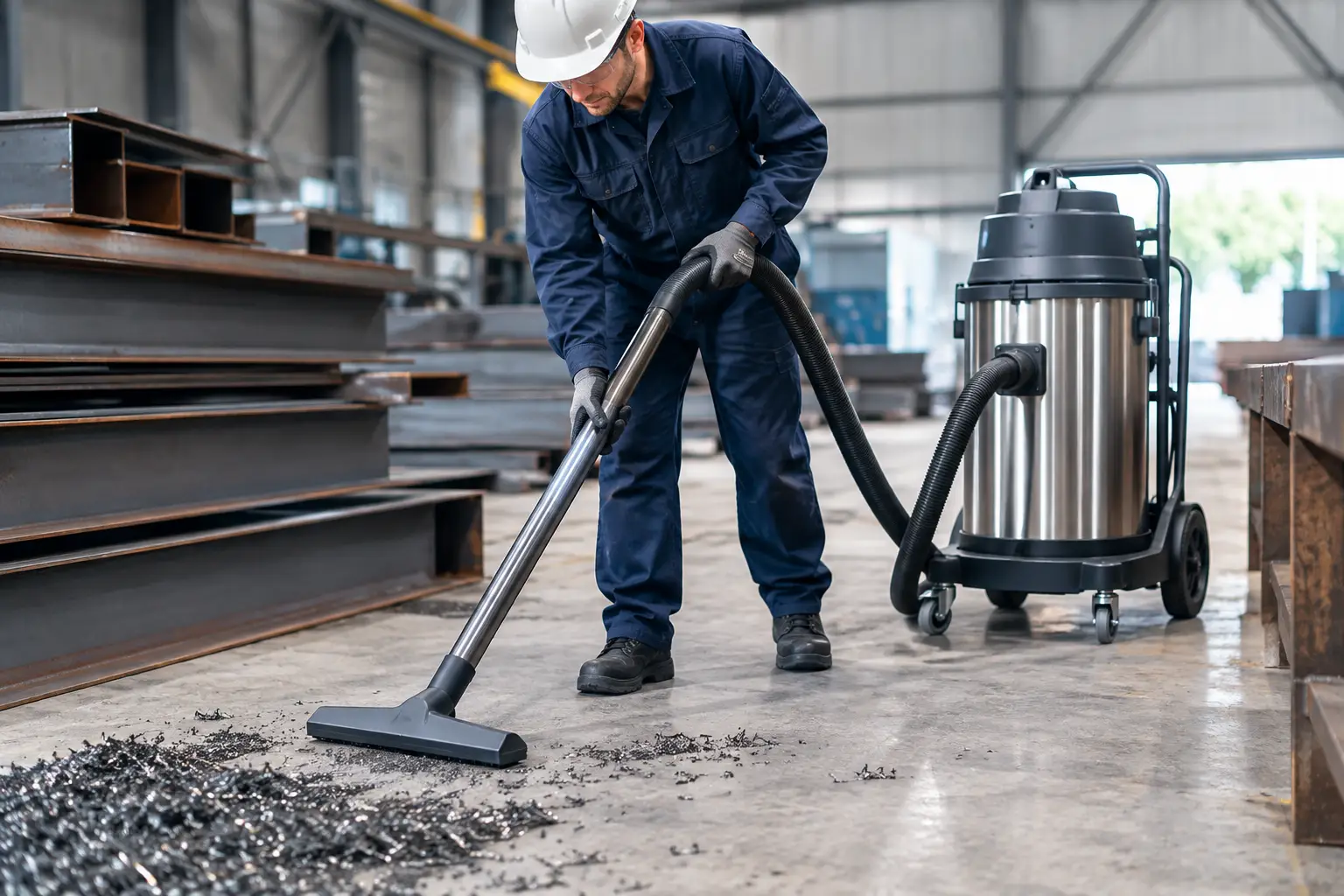
A furnace floor covered in mill scale, a maintenance bay full of oily swarf, and a shot-blasting area carrying fine dust do not present the same cleaning problem. Choosing the best vacuum for steelworks cleanup means starting with the material, its condition and the way it is generated – not with a tank size or a headline motor rating.
Steelworks demand equipment that can operate around heat, heavy particulate, sharp metal waste, oil and continuous production activity. A domestic or light commercial machine may remove surface dust for a short period, but it is not designed for the duty cycle, recovery volumes or safety controls required on an industrial site. The right vacuum should improve housekeeping without creating a new maintenance burden, interrupting production or exposing operators to avoidable risk.
What makes steelworks cleanup different?
Steel production, fabrication and maintenance activities create a varied waste stream. Mill scale can be abrasive and dense. Metal swarf is sharp, often mixed with coolant, and can block unsuitable hoses or damage filters. Fine metallic dust and blast media can travel across work areas, while powders generated from cutting, grinding or furnace processes may require specific containment and filtration measures.
The operational setting matters just as much. A vacuum used for a scheduled end-of-shift clean will have different requirements from one serving a maintenance team on call, or a fixed system recovering waste directly from a process. The best result is rarely the largest machine available. It is the unit configured for the actual material, collection frequency, travel distance and disposal method.
There is also a safety question. Certain metal dusts can present a combustible dust risk when they are sufficiently fine and present in the right concentration. Dust may also contain contaminants that require controlled handling. A proper assessment of the material and area classification should determine whether ATEX-certified equipment is necessary. It should never be treated as a standard add-on without considering the application.
Best vacuum for steelworks cleanup: match the machine to the job
A suitable industrial vacuum starts with four practical decisions: what is being recovered, whether it is dry or wet, how far it must travel, and how often it will run. These factors determine suction performance, airflow, filtration, hopper design and the most appropriate discharge arrangement.
Heavy dry material: mill scale, slag and blast media
Mill scale, grit and settled process debris require high suction performance and a collection container that can withstand abrasive use. If material is collected from floor level over short runs, a three-phase industrial vacuum with a sizeable hopper is often appropriate. Three-phase machines are suited to long operating periods and repeated use, particularly where a single-phase supply would limit output or lead to overheating.
For heavier fractions, do not focus solely on airflow. Depression, often referred to as vacuum pressure, is central to lifting dense material. The machine also needs a practical way to empty the recovered waste. A detachable container, forklift-discharge hopper or tipping arrangement can save significant handling time where collection volumes are high.
Filter protection is equally important. Large particles and abrasive material can damage a poorly positioned filter or reduce its service life rapidly. A staged separation arrangement, such as a pre-separator or cyclone, can remove heavier material before it reaches the main filtration stage. This helps maintain consistent performance and reduces filter-cleaning downtime.
Swarf, coolant and cutting oil
Machining areas often need wet and dry recovery rather than dust extraction alone. A suitable machine must separate solids from liquids, retain swarf safely and allow coolant or oil to be recovered, filtered or disposed of in line with site procedures.
For this application, a vacuum with a metal collection tank, chip basket and liquid-level control is often more useful than a general dry vacuum. The aim is to remove swarf efficiently while preventing liquid from reaching the motor or creating an awkward, messy emptying process. If coolant recovery is frequent, a discharge pump or a dedicated filtration system may be justified.
The trade-off is capacity versus manoeuvrability. A large unit reduces emptying frequency but may be difficult to position between machine tools. In a compact maintenance area, a smaller mobile machine assigned to a defined group of machines may deliver better day-to-day use.
Fine dust from grinding, cutting and blasting
Fine dust creates a different challenge. The priority becomes filtration efficiency, safe containment and maintaining airflow as the filter loads. A machine designed for fine dust should have filtration rated for the material risk, with an effective filter-cleaning mechanism where the duty demands it.
For high volumes of fine powder, a manual filter shaker may not be enough. Automatic or continuous cleaning systems maintain suction more consistently during extended cleaning, reducing pauses for the operator. A pre-separator can still be valuable, but it must be matched to particle size and flow conditions rather than selected as a default accessory.
Where hazardous dust is confirmed, the vacuum specification must follow the site risk assessment. This may involve ATEX-certified equipment, conductive components, grounding arrangements and specialist filters. Certification applies to a defined configuration and intended zone, so every hose, accessory and recovery method must be considered as part of the system.
Mobile cleaning versus fixed recovery
Portable vacuums are the right choice when cleaning points change, maintenance work is reactive or teams need equipment across several bays. They provide flexibility, but the machine must be easy to move over uneven floors and its hose length must suit the work area without causing pressure loss or trip hazards.
A centralised vacuum system can be a stronger option where the same material is recovered repeatedly across a large facility. Fixed pipework can serve multiple pickup points, allowing operators to use local hose stations rather than move a vacuum through production. This approach can improve housekeeping consistency and reduce manual handling, particularly in areas with a regular dust or waste load.
The investment is higher and system design matters. Pipe diameter, pickup-point demand, material velocity, separation and final discharge all need to reflect the process. A fixed system designed only around today’s cleaning routine can become restrictive when production changes, so anticipated expansion should be discussed at the design stage.
The specification details that affect real performance
Motor power is only one part of the decision. A well-specified steelworks vacuum balances airflow and vacuum pressure for the material being lifted. Dense scale needs lifting force; fine dust often benefits from adequate airflow and controlled filtration; long hose runs require careful system sizing to compensate for losses.
Pay close attention to construction. Steel tanks, abrasion-resistant hoses, metal accessories and durable castors are sensible in areas where sharp swarf, impact and hot residue are possible. However, material temperature needs checking before collection. A standard industrial vacuum is not automatically suitable for hot ash, hot scale or potentially glowing particles. Those applications may need specialist heat-resistant components, a cooling process or a different recovery method.
Noise level and ergonomics also affect whether a machine gets used properly. If a unit is difficult to steer, awkward to empty or too loud for a busy maintenance environment, operators may avoid using it until the problem has become larger. Practical details such as hose storage, accessory holders and a clear fill-level arrangement have a direct effect on housekeeping standards.
Questions to answer before selecting a vacuum
Before comparing models, define the application in operational terms:
- What material is being recovered, including particle size, weight, temperature and moisture content?
- How much material is generated per shift, and is recovery planned or reactive?
- Is the material dry, wet, oily or a mixture of all three?
- Does the area assessment identify combustible dust, hazardous substances or an ATEX zone?
- How far must the material travel through hose or pipework?
- How will recovered material be emptied, recycled or disposed of?
These answers prevent common specification errors, such as choosing a fine-dust machine for heavy scale, selecting a large tank that cannot be safely emptied, or fitting a standard vacuum into a hazardous area.
Consider the total cost of ownership
The cheapest purchase option can prove expensive if filters clog frequently, consumables wear quickly or the machine is undersized for the cleaning routine. Downtime, operator time and waste-handling effort should be considered alongside the initial equipment cost.
A correctly matched industrial vacuum can support cleaner walkways, safer maintenance access and faster recovery of valuable materials such as swarf or blast media. It can also reduce the spread of dust to adjacent equipment, helping protect machinery and simplify routine cleaning.
Forvac Industrial approaches steelworks applications as a system question rather than a catalogue choice. A site assessment can identify whether a portable wet-and-dry unit, heavy-duty three-phase vacuum, pre-separation arrangement or fixed central system will provide the most cost-effective result.
The useful next step is to collect a representative sample of the waste and observe the cleanup process over a normal shift. That evidence gives engineers and maintenance teams a sound basis for choosing equipment that will keep working when the site is at its busiest.
